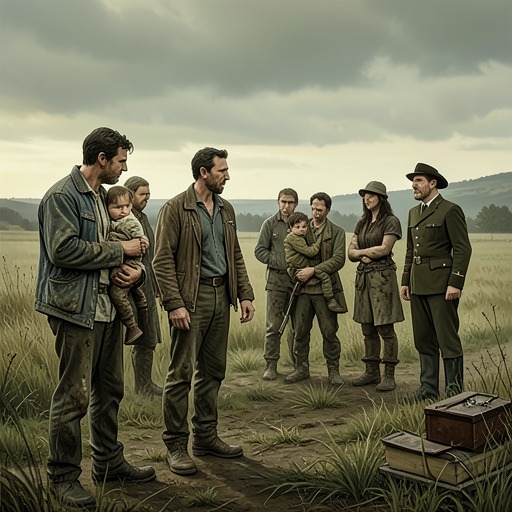
Care for Migrant Workers and Barriers to Medical Care
East of the MountainsCare for Migrant Workers and Barriers to Medical Care is presented through a crisis on a Greyhound journey, where Ben Givens tries to secure treatment for Angel, a seriously ill young man traveling with fruit pickers. The episode makes care a practical negotiation: Ben recognizes the urgency, but the sick man’s companions fear deportation and cannot afford a hospital, while the people and institutions able to help disagree about what the law and financial assistance permit. The surrounding orchard story places this emergency within a larger pattern of mobile, seasonal labor and precarious access to care.
Seasonal Labor and Precarity
The novel establishes the agricultural context through the Givens family’s orchard, where work follows the seasons and the fruit harvest depends on migrant pickers. Their arrival is part of a northward circuit through successive crops: after picking strawberries in California, laborers move through plums and pears, then arrive for cherries and peaches before the apple harvest. Some travel with families; others are single men or drifters. They reach orchards by pickup truck, freight train, or on foot, carrying their belongings and seeking short periods of work. That mobility is a source of livelihood, but it also leaves workers exposed to unstable employment and separation from familiar support.
The bus episode shows how legal status compounds those vulnerabilities. Ben understands that the three young travelers lack green cards and are afraid they will be deported. The fear shapes what they are willing to accept: Catherine Donnelly has to reassure them that Ben is not the police and will not report them before they can discuss Angel’s illness. The exchange does not treat the concern as a misunderstanding that can simply be dismissed. It is a real constraint on seeking help, even as Ben insists that Angel’s immediate condition must come first.
The Emergency on the Bus
Catherine translates between Ben and the young men, whose English is limited or absent. Ben initially offers a tentative medical assessment, considering tuberculosis or pneumonia among several possible causes, but he is careful about the limits of what he can do. He has no medical equipment with him, not even a stethoscope, and tells Catherine that Angel needs a clinic or hospital as soon as the bus reaches Wenatchee, Washington. He warns that the illness could worsen and become fatal without prompt care. Catherine, in turn, points out that a hospital may ask for identification or immigration papers, potentially placing Angel at risk of deportation. The need for treatment and the fear of seeking it are thus present in the same conversation.
When the passengers leave the bus, Ben decides to call 911. At the station at First and Chelan, he identifies himself to the emergency operator as a doctor and explains that Angel is seriously ill, has coughed up blood, and needs immediate assistance. He answers questions about his credentials, the symptoms, and the journey from Quincy. An ambulance arrives within minutes, and Ben directs the emergency technicians to Angel, telling them that he suspects tuberculosis and that the young man needs a hospital workup. His professional knowledge gives him a way to make the danger legible to the responders, but it does not resolve the fears that have kept the travelers from seeking care.
Cost, Status, and Institutional Disagreement
The argument shifts from medical urgency to the cost and consequences of transport. Angel’s brother says he will not let Angel go because he feels responsible for him; Catherine explains that the group has no money for a hospital. Ben tells her to reassure them that they will not have to pay and argues that federal assistance exists, insisting that treatment is the central issue. Coleman, one of the emergency technicians, disputes that assurance and says undocumented patients are not covered. Odle offers a qualification: the hospital may be able to apply for welfare assistance through the Emergency Medical Office. Coleman remains skeptical, citing previous experience.
The disagreement matters because reassurance alone cannot make the financial barrier disappear. Ben’s promise is an attempt to get Angel through the immediate crisis, not proof that the bill will be covered; the technicians themselves do not agree on the available assistance. The scene leaves that administrative question unresolved while showing its consequences for decision-making. A brother weighing whether to surrender responsibility, a translator trying to keep trust, a physician pressing for treatment, and responders disputing eligibility all shape whether the patient can reach care.
Angel’s brother eventually boards the ambulance with him, but Coleman refuses to transport the third young man. He says there is no legal place for him in the vehicle and that the hospital is within walking distance. The separation makes the limits of emergency transport concrete: Angel leaves for treatment with his brother, while the other traveler is left behind at the station. Catherine has already departed on the bus, and Ben watches the remaining boy before returning inside. The episode does not report Angel’s later medical outcome, and it does not settle whether the hospital assistance will materialize.
Care Beyond the Emergency
Ben’s response to the third traveler turns from crisis intervention to practical support. They cannot communicate easily, so Ben uses a dictionary and gestures. The young man, Emilio, makes clear that he wants work picking apples rather than a hospital visit. Over a meal, Ben learns that Emilio is not Angel’s brother: he had met the other two while picking pears near Yakima, joined them because they knew of apple work, and still hopes to find employment. Ben does not press him for a personal history that Emilio has not offered. He feeds him, buys him apple pie and milk, and calls the Job Services Office to ask about agricultural jobs. The specialist tells him the available work is short-term and that the apple harvest is nearly finished.
Ben continues looking for a route into work at Wolfhound Orchard. There, contractor Lyle Parmenter checks Emilio’s worn employment card, bearing the name Raul Ramirez, and fills out a Department of Justice employment eligibility form. Parmenter also examines Ben’s Washington State identification before asking whether he has picked apples and warning that the work is demanding. The scene connects help to the concrete requirements of hiring: a willing worker’s need for wages must pass through paperwork, an employer’s scrutiny, and a harvest that will soon end. The orchard camp, with its cabins, washhouse, creek, and trailers, gives this labor a physical setting rather than leaving seasonal workers as anonymous figures on the road.
The care theme extends beyond the bus. At the orchard camp, Ben recognizes that a laboring woman’s baby is already showing and that it is too late to reach a hospital; he turns to the immediate work of responding where they are. This moment, like the ambulance episode, places medical need against the limits of distance and access. Across the scenes, care is neither a general sentiment nor a substitute for formal treatment. It appears as attention to a person’s stated need, clear recognition of danger, translation, food, a call for emergency help, or an attempt to find work—and it is repeatedly tested by money, documentation, transport, and the narrow time window of seasonal employment.